
OCR vs Swap Rates NZ: What They Mean for Fixed Mortgage Rates
- By Lydia Chen - Last updated on 21.07.2026
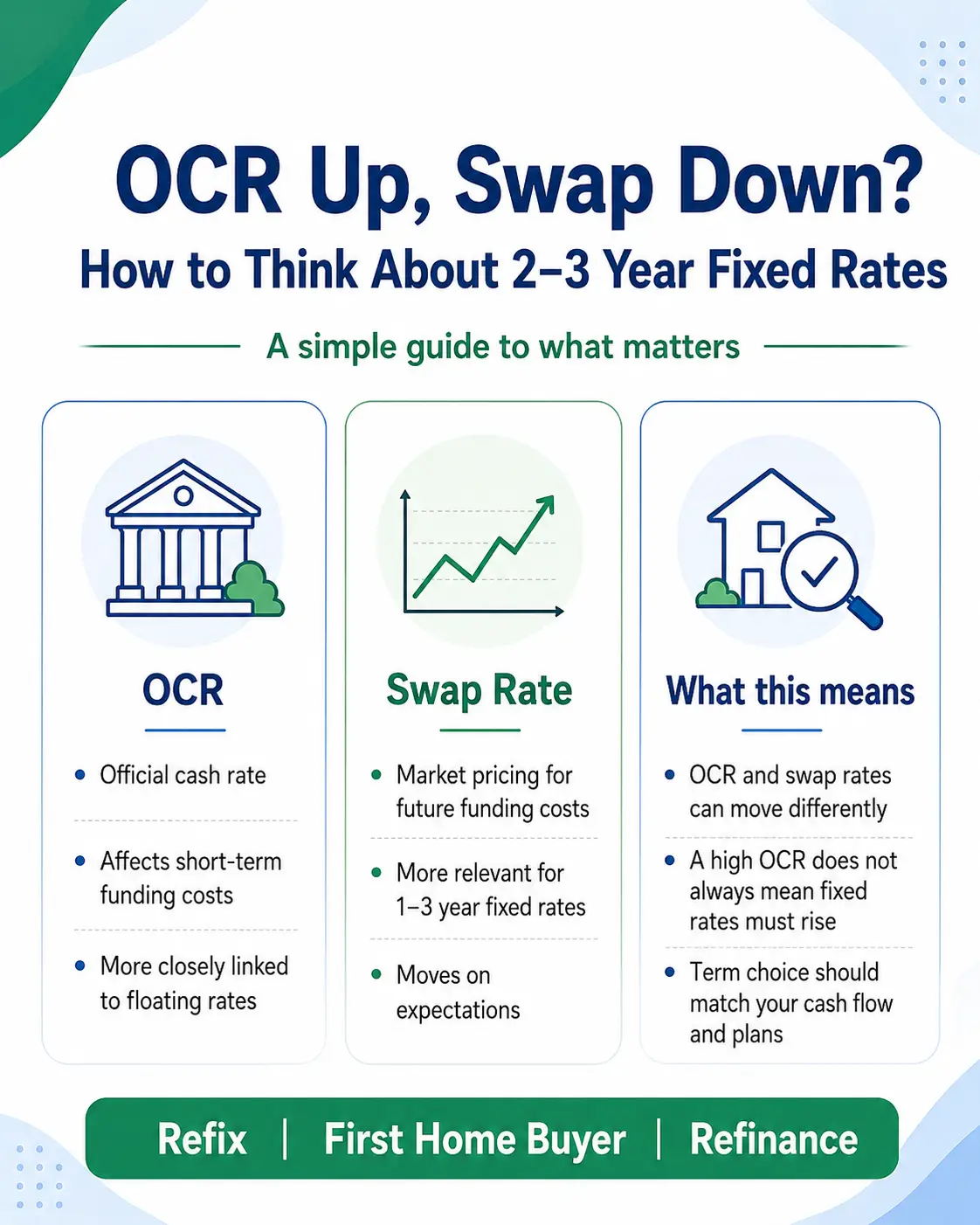
OCR Up? Why Fixed Mortgage Rates May Move Differently
When the Reserve Bank changes the Official Cash Rate, mortgage rates quickly become a major topic.
However, an OCR increase does not always mean that every fixed mortgage rate will immediately increase. It is also possible for some fixed rates to fall while the OCR remains high.
That is because banks do not set fixed mortgage rates using the OCR alone.
For homeowners approaching a refix, first-home buyers comparing loan terms, or borrowers considering refinancing, understanding the difference between the OCR and swap rates can help you make a more informed decision.
Your fixed term is ending soon?
A mortgage review can help you compare different fixed terms, repayment amounts and loan structures before you accept a new rate.
What is the OCR?
The Official Cash Rate, usually called the OCR, is an interest rate set by the Reserve Bank of New Zealand.
The Reserve Bank uses it as part of monetary policy to influence inflation and economic activity. It has a direct influence on overnight interest rates in the banking system and is an important reference point for short-term borrowing costs.
OCR changes can affect:
- Floating mortgage rates
- Revolving credit rates
- Short-term deposit rates
- Banks’ short-term funding costs
- Expectations about future interest rates
However, banks do not normally increase or decrease every mortgage rate by exactly the same amount as an OCR change.
Reserve Bank research shows that OCR changes do flow through to mortgage and deposit rates, but the adjustment is usually gradual rather than immediate.
What is a swap rate?
An interest-rate swap is an agreement in which two parties exchange fixed and floating interest payments.
For mortgage borrowers, the technical details are less important than the main point:
Swap rates provide a wholesale market benchmark that banks can use when pricing fixed-term lending.
There are different swap rates for different periods, including one-year, two-year, three-year, five-year and longer terms.
For example, the two-year swap rate is one of the market benchmarks that may be relevant when a bank is considering the cost and pricing of two-year fixed lending.
However, a swap rate is not the mortgage rate offered to a customer. It is only one part of the bank’s pricing calculation.
OCR and swap rates are not the same
The OCR mainly represents the current setting of monetary policy.
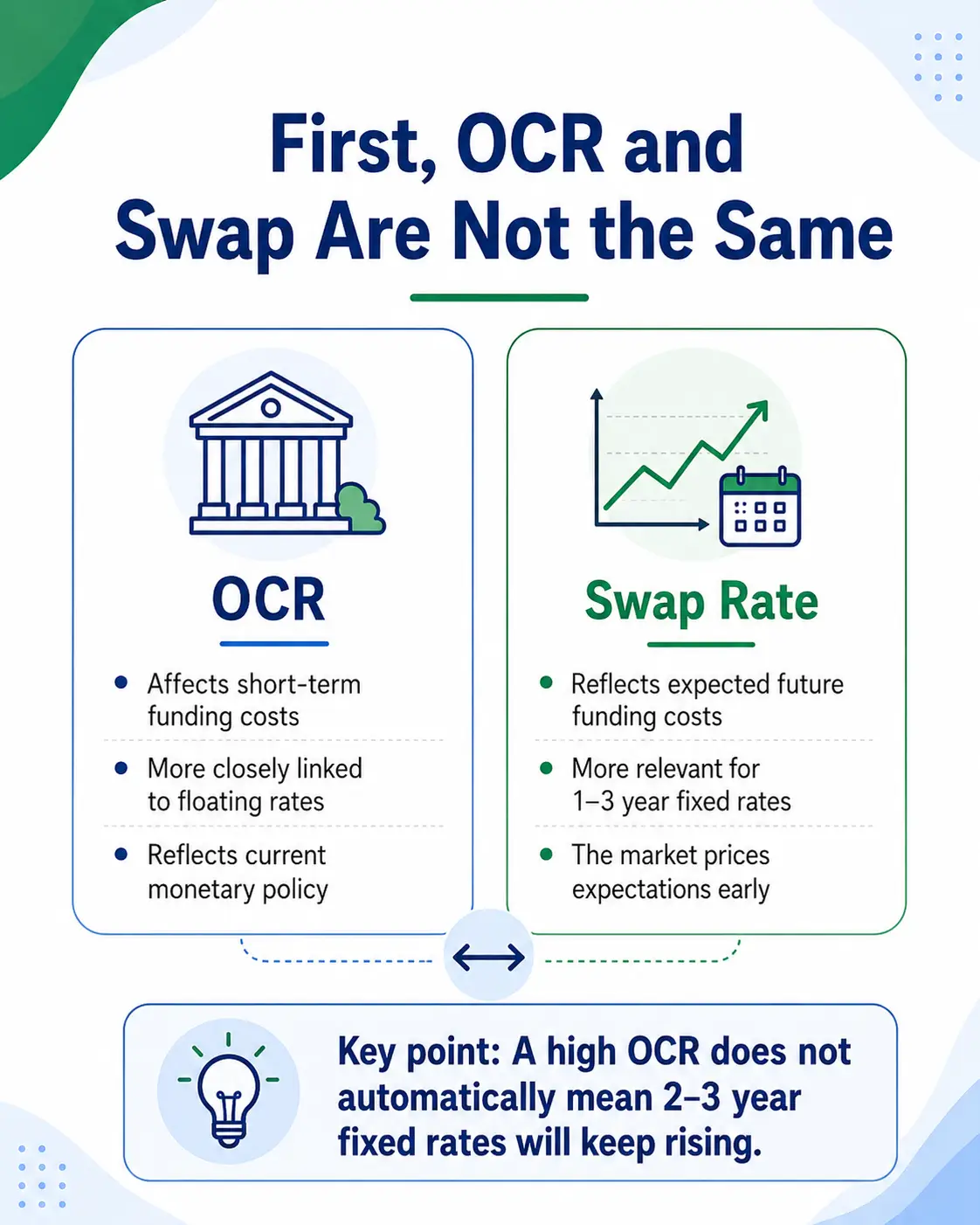
Swap rates are market prices. They can reflect expectations about:
- Future OCR decisions
- Future inflation
- Economic growth
- International interest rates
- Demand for fixed and floating interest-rate exposure
- Financial market risk
However, banks do not normally increase or decrease every mortgage rate by exactly the same amount as an OCR change.
Reserve Bank research shows that OCR changes do flow through to mortgage and deposit rates, but the adjustment is usually gradual rather than immediate.
The key point
The OCR tells us where monetary policy is now. Swap rates tell us more about how financial markets are pricing interest rates over a future period.
They are connected, but they do not have to move together every day.
Why can fixed mortgage rates move before the OCR?
Financial markets constantly respond to new information.
This can include:
- Inflation figures
- Employment data
- Economic growth
- Oil and freight costs
- Exchange-rate movements
- Reserve Bank comments
- Overseas central-bank decisions
- Political and international events
When the market’s expectations change, swap rates can move quickly.
Banks may then review their fixed mortgage rates, even when there has been no new OCR announcement.
This is why waiting for the next OCR decision does not guarantee that a fixed rate will become cheaper. The market may have already priced in the expected decision.
What actually determines a fixed mortgage rate?
Swap rates are important, but they are not the whole story.
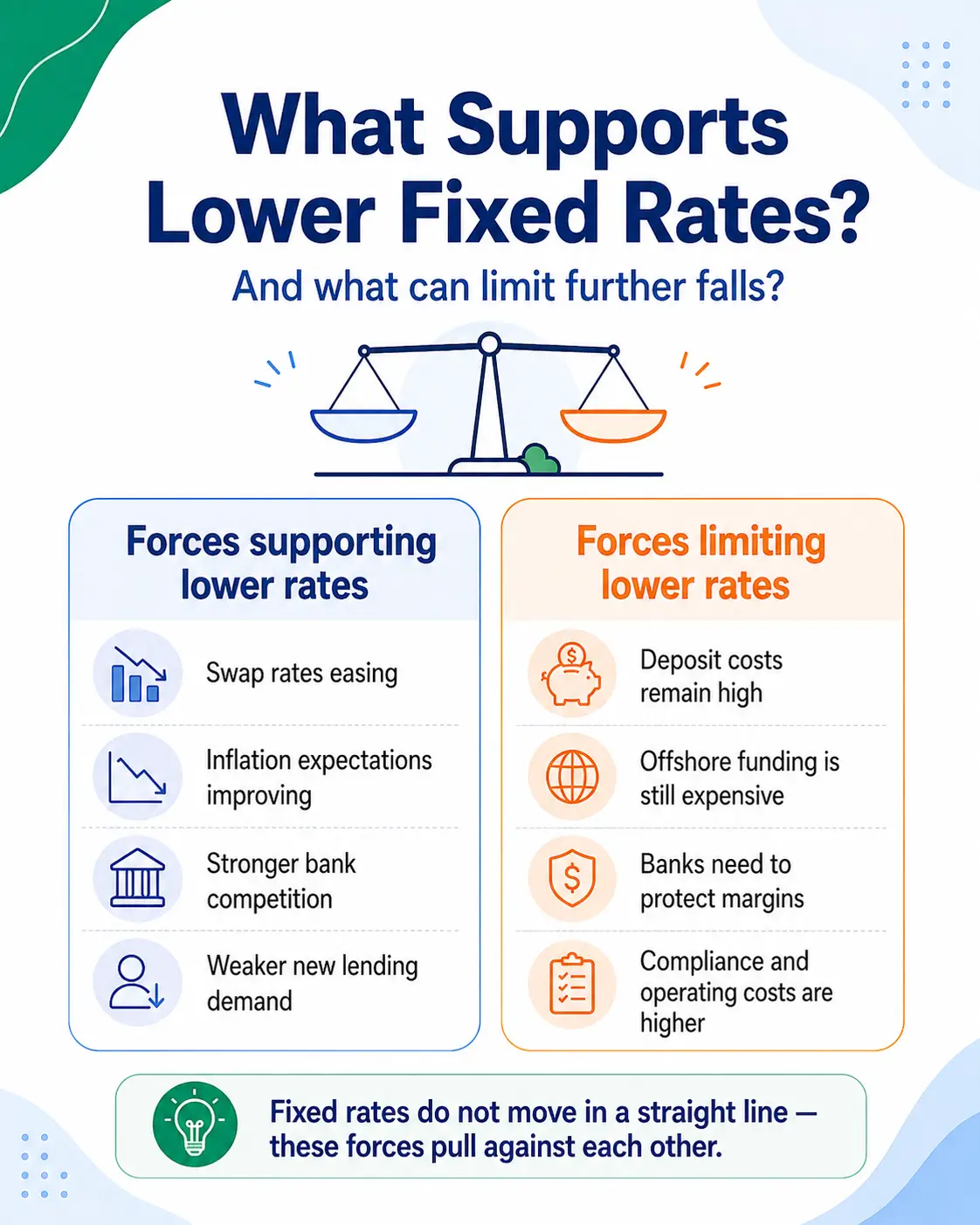
A bank generally considers several components when setting a mortgage rate.
1. Wholesale interest-rate benchmarks
Banks may use the OCR and swap rates at different terms as benchmarks when calculating the opportunity cost of providing new loans.
2. Deposit costs
Customer deposits are an important source of bank funding. If banks need to offer higher term-deposit rates to attract money, this can place upward pressure on lending costs.
3. Offshore and wholesale funding
New Zealand banks may also obtain funding from wholesale markets. The price of this funding can be above the underlying swap rate because of credit risk and term premiums.
4. Liquidity and capital costs
Banks must manage liquidity and hold capital against their lending. These requirements contribute to the final cost of providing a home loan.
5. Operating costs and expected losses
Technology, staff, compliance, loan administration and expected credit losses are also included in bank pricing.
6. Competition and bank margins
A bank may temporarily offer a sharper rate because it wants more mortgage customers or wants to retain existing borrowers.
The Reserve Bank explains that banks start with funding benchmarks and then add funding premiums, liquidity costs, capital costs, operating costs, expected losses and the bank’s required profit margin.
What does this mean when you are refixing?
It means you should be careful about choosing a fixed term based only on an OCR headline.
A forecast that rates may eventually fall does not automatically mean that the shortest fixed term is the best choice.
Similarly, a recent OCR increase does not automatically mean you should immediately lock in the longest available term.
A suitable structure depends on your own circumstances.
Before choosing a term, consider:
- The repayment you can comfortably manage
- How much certainty you need
- Whether you may sell the property
- Whether you may refinance or change banks
- Whether your income could change
- Whether you expect a large expense
- Whether you want to make extra repayments
- The possible cost of breaking a fixed loan
- Whether splitting the loan could reduce timing risk
The lowest advertised rate is not always the most suitable option once flexibility, fees, cashback conditions and your future plans are considered.
Who might consider a two- or three-year fixed rate?
A longer fixed term may suit someone who values certainty more than short-term flexibility.
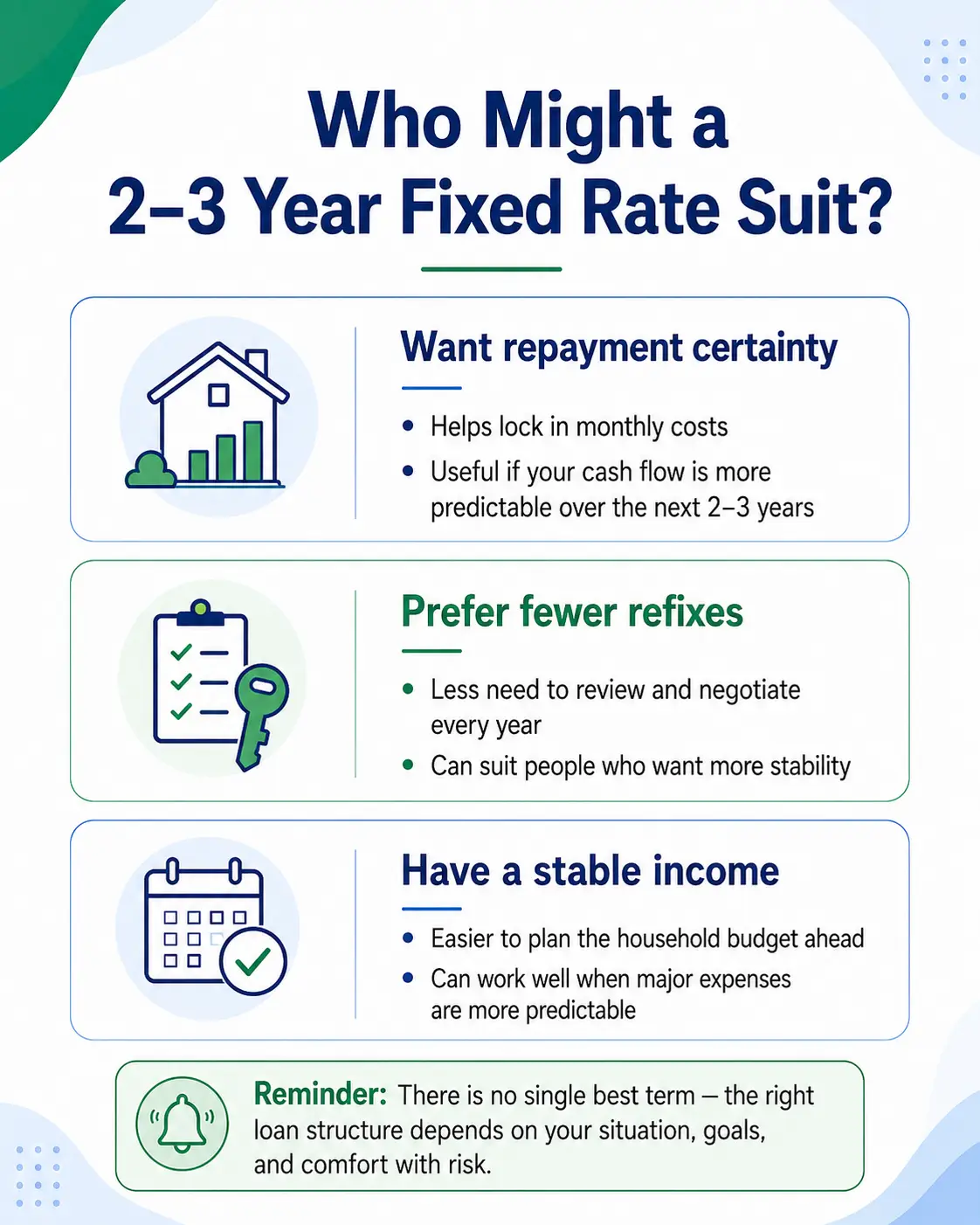
It may be worth considering when:
You want predictable repayments
Fixing for two or three years can make household budgeting easier because the interest rate will not change during the fixed period.
You prefer fewer refix decisions
Some borrowers do not want to review and negotiate their mortgage every six or twelve months.
Your income and plans are relatively stable
A longer term may be more practical when you do not expect to sell, refinance or make major changes to the loan.
You are uncomfortable with interest-rate uncertainty
Even when a shorter term could potentially become cheaper, some borrowers prefer knowing what they will pay.
However, a two- or three-year term may provide less flexibility. Breaking or changing a fixed loan early can result in costs, depending on the lender, market rates and loan conditions.
When might a shorter term be considered?
A shorter term may be worth reviewing when:
- You expect to sell or restructure the property
- Your circumstances may change soon
- You want another opportunity to review the loan earlier
- You can manage the risk of repayments changing
- You believe flexibility is more important than certainty
This does not mean a shorter term will definitely save money.
It simply gives you another refix date sooner. The interest rate available at that future date is unknown.
Could splitting the mortgage help?
Some borrowers divide their mortgage into two or more fixed portions.
For example:
- Part fixed for one year
- Part fixed for two years
- A smaller floating or revolving-credit portion
This means the whole mortgage does not expire on the same date.
A split structure can reduce the risk of having the entire loan refix during an unfavourable period. However, it can also make the loan more complicated and may make switching banks more difficult when the portions expire at different times.
The structure should match your repayment ability, plans and need for flexibility.
There Is No Single Best Fixed Term
No one can know with certainty what mortgage rates will be in one, two or three years.
Economic forecasts and swap rates can provide useful information, but forecasts can change when new inflation, economic or international information becomes available.
The right question is not only:
“Which rate is the lowest today?”
It is also:
“Which loan structure gives me a suitable balance of cost, certainty and flexibility?”
Your Fixed Term Is Ending Soon?
Before accepting the new rate offered through your bank’s app or online banking, it may be useful to review the wider picture.
A mortgage review can help you consider:
- Your current bank’s refix offer
- Six-month, one-year, two-year and three-year options
- Estimated repayments under each option
- Fixed, floating and split structures
- Your future property plans
- Refinancing or switching-bank costs
- Cashback conditions and possible clawbacks
- Opportunities to reduce interest over time
You may not need to change banks. Sometimes the most suitable outcome is to stay with your current lender but adjust the loan structure.
Frequently Asked Questions
No. OCR changes influence mortgage rates, but fixed rates are also affected by swap rates, deposit costs, wholesale funding, competition and bank pricing decisions. The market may also have anticipated an OCR change before it was announced.
No. A swap rate is a wholesale market reference rate. A mortgage rate is the final retail rate offered by a lender after funding costs, risks, operating costs, capital requirements and margins have been considered.
Not necessarily. Swap rates and bank offers can change before an OCR announcement. Waiting may produce a better offer, a worse offer or very little change. The decision should also take account of your fixed-rate expiry date and need for repayment certainty.
It provides more repayment certainty, but it can reduce flexibility. Whether it is suitable depends on your plans, cash flow and comfort with interest-rate risk.
Not automatically. You should also consider fees, cashback conditions, loan flexibility, extra repayment rules and what may happen if you sell or refinance before the fixed term ends.
In many situations, yes. Splitting can stagger your refix dates, but it may also make the mortgage more complicated. The benefits and disadvantages should be considered before the loan is divided.
Request a Refix and Loan Structure Review
Send through your approximate loan balance, current lender and fixed-rate expiry date. Your situation can then be reviewed before you make a new commitment.
Albany Office
- 1E/3 Ceres Court, Rosedale,
- Auckland 0632
Mt. Eden Office
- 56 Mt. Eden Road,
- Auckland 1024
Hours
- Mon- Fri: by appointment
- Saturday: by appointment
Contact:
- Lydia Chen
- 021 024 67321
- License FSP1010614
Email:
- Lydia@applemortgage.co.nz